Showing posts with label boy's birthday cake. Show all posts

Saturday, 10 March 2012

How to Make a Parcel-burst Cake - Tutorial

I have always been impressed when I have seen cakes with 'things' apparently bursting out of the top of them and I thought I would share with you how I put one together recently.

I decided that I would airbrush the cake afterwards, rather than colour the fondant beforehand. I'm not sure that was such a great idea now, but I was happy with the end result so it all turned out OK in the end.

So first of all I rolled out some fondant and used the tin I baked the cake in as a 'cutter' to make a circle the right size to go on the top of the cake.


I then cut out a circle of greaseproof paper, using a smaller tin as a guide, and popped that on top of the fondant circle, before covering the cake properly.


I then lightly placed the smaller tin on the top of the cake which left a slight indentation that I could use as a guide to cut slits into the fondant. Be careful when doing this. The greaseproof paper acts as a guard to stop you from cutting through the second layer, but if you put too much pressure on the knife/cutter then it will pierce the paper and the layer underneath. Once I'd cut the slits, I peeled back the pieces and gently curled them into a nice shape.


I then was able to remove the greaseproof paper to reveal the perfect layer of fondant underneath to protect the cake. I had thought that I would be able to simply 'pinch' the paper to pull it out, but it proved more difficult than I anticipated. In the end I used the point of a knife to gently hook it out, strategically choosing a place where I knew the topper would be inserted so that any blemish wouldn't be visible.


I then set about airbrushing the cake. As the fondant still  had a little flexibility at this stage, I was able to place a sheet of paper towel under each of the pulled back pieces to protect the main body of the cake while I airbrished it in red. I then did the rest of the cake blue and managed reasonably sucessfully not to get blue contaminating the red parts. Obviously it would be easier to do this with pre-coloured fondant, but I don't seem to like doing things the easy way :o)


I think the end result is quite effective, and it certainly adds an extra dimension to a cake.

This is just the way I worked out how to do this - if you have other tried and tested methods, I would love to hear about them!

Friday, 3 February 2012

How to Make a Gumpaste Wizard - Tutorial


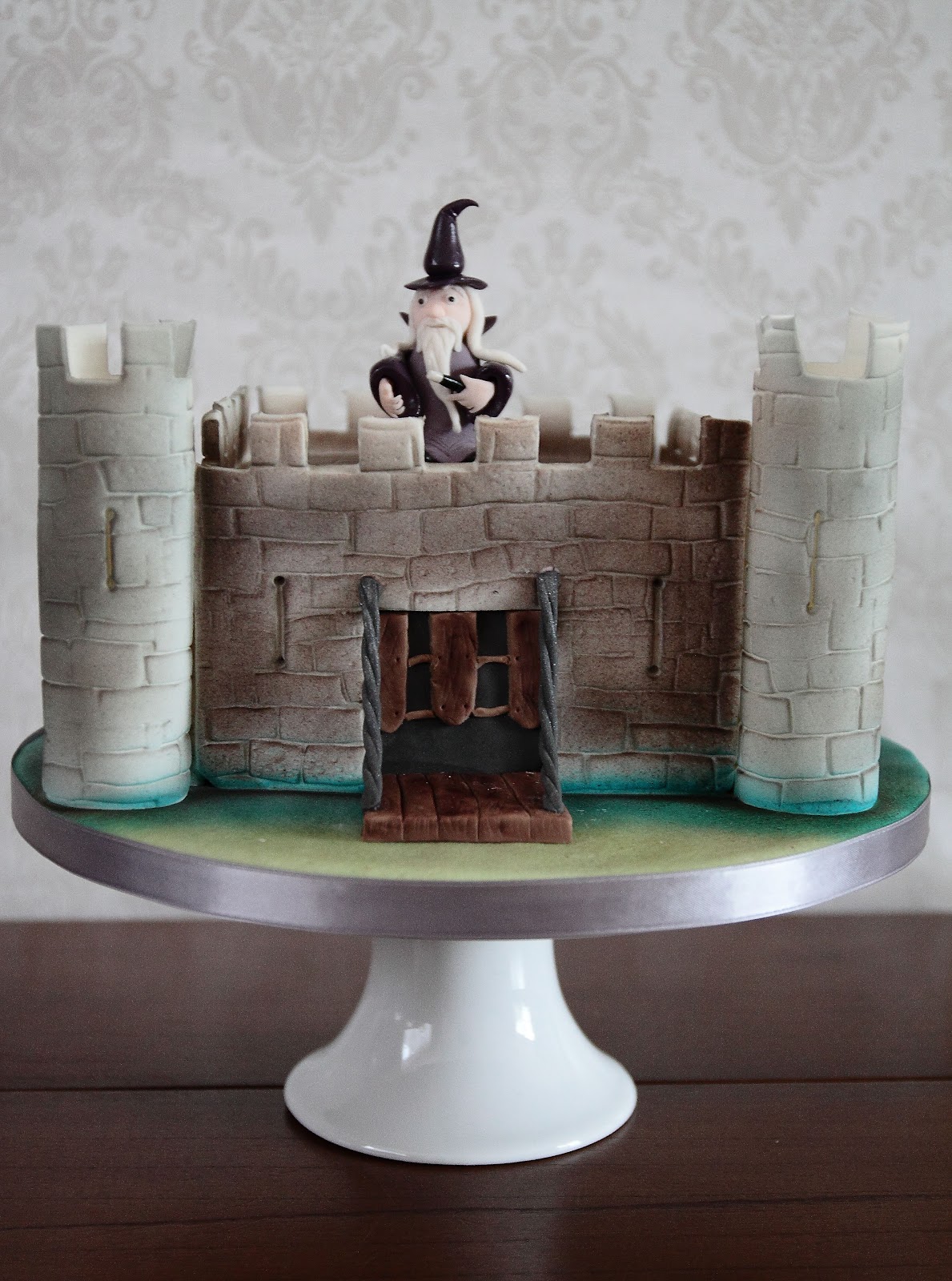
The finishing touch to the castle cake (see tutorial How to Make a Castle Cake - Part 1 and How to make a Castle Cake - Part 2) was the wizard sitting on the top so here is how I made him:

First I rolled a ball of gumpaste into an appropriate size for his body, gently moulding it into a a flattened pear-shape.

Then, using my thumb and forefinger, I flared out the bottom to give the impression of some movement, so it would look like he was wearing a gown.


I then rolled out two small tear-dropped shaped balls of black gumpaste and stuck them into place under the gown. I used the dresden tool to put in some folds around the shoes. 


I always like to make sure that the heads of my figures are secured well onto the body while drying, so I inserted a spaghetti stick through the body (this can also help prevent sagging).


To make his head I rolled a ball of flesh coloured fondant and used a cocktail stick to make a little hole where his nose would be. I then rolled a small tear-dropped shaped piece of flesh coloured fondant and put it in place to make his nose. I used a cocktail stick to give the nose nostrils. The eyes are simply small balls of white gumpaste upon which are glued even smaller balls of black gumpaste (I used sugar glue, but you could just as easily use water). I fashioned his eyebrows from small tapering sausages of white gumpaste and used the dresden tool to give them some texture once I'd stuck them into position. Finally, I put his head in place and was then able to cut off the excess spaghetti, leaving just enough to support his hat.  


Of course, being a very wise old wizard, he had to have a substantial beard. I made this from a long tapering sausage of white gumpaste, which I then added texture to using the dresden tool.


The beard was too long when I first held it against him, so I chopped the end until I got to a length that I was happy with and then attached it to his face just under his nose.


I then attached a moustache above it (again using the dresden tool to texture it and coax it into position) and gave him the suggestion of a mouth through all that facial hair!


I then got carried away with all this hair and started putting it on his head, completely forgetting that I had intended to put a cloak on him, so next time I would do that step first to make things easier! So, using similar principles to the beard, I filled his head with hair.


I then rolled a thing piece of darker gumpaste and cut a cloak out of it. I did this freehand, but you may want to make yourself a template to ensure it's even.

Luckily, when I came to attach the cloak, the hair was still soft enough that I could manipulate it out of the way so my earlier eagerness didn't result in disaster (phew).


I then gave him arms. To make these I rolled two tear dropped pieces of gumpaste and then fluted the ends using my thumb and forefinger to give the appearance of the long sleeves. Using the small ball tool, I made holes in the end for his hands. As his arms were quite heavy, once they were glued in place, I supported them with sponges until they were dry enough to support themselves. 


For his hat, I rolled a thin piece of gumpaste and cut out a disk for the rim. I then rolled a tear-drop shaped piece of gumpaste, which I thinned to almost a point at the end, to make the body of his hat. It simply slotted into place on top of the disk and was supported by, and completely covered, the last part of the spaghetti that had been protruding out of his head.


Finally, he needed some hands. If you check out my earlier post (Gumpaste Hands) there is a great link to a Lorraine McKay tutorial on making hands which I have found invaluable and I am sure you will find interesting at the very least.
To make hands, you start with two tear-dropped shaped pieces of gumpaste (everything seems to be tear-drop shaped today, doesn't it?) and you flatten them out at one end so that they have an almost paddle shape.


Then, using a knife or a scalpel (it was a scalpel in this case as these hands were tiny!) cut the paste to give rudimentary fingers and thumbs.


Next is the tricky bit, and where Lorraine's tutorial is really good at demonstrating the technique. To make the fingers look more realistic, you have to gently roll each individual finger, slightly pulling to elongate and tapping the end to shape. In the picture below you can see the difference between the shaped and the unshaped fingers. 


Once you get the hang of it and can do this step relatively quickly, the gumpaste should still be flexible enough for you to position the fingers into realistic poses. It's not so clear below because of the sponge in the way but I made a little magic wand for the wizard to hold and was able to manipulate the fingers so that he was gripping it.


I allowed the figure to dry overnight before positioning him on top of the cake. By that time his arms and hands were dry enough to be able to support themselves without the help of the sponges.

I hope you have found this helpful. I would love to see some of your own creations!

Wednesday, 1 February 2012

How to Make a Castle Cake Tutorial - Part 2


This is the second part of my tutorial on how to make the castle cake pictured above. For the first part please see here.

Previously we made the turrets, covered and coloured the board and placed the cake in position; so now it is time to make the walls. 

First, I rolled out a piece of fondant to the appropriate thickness (depends on how thick you like your icing on the cake) and cut it to the length of the side wall. The height was slightly taller than the height of the cake as I needed to allow for the battlements.


As with the turrets, I used the impression mat to give the look of a stone wall and I used a small square cutter to cut out the battlements. Then I cut in three arrow slits using the method described in part 1.


As the fondant is soft and it can be difficult to stop the shape distorting while handling it, I popped it into the freezer for a minute or two just to cool down and stiffen up. This allowed me to then put it in place without any stretching or distortion. You can use a very thin layer of buttercream, or jam or sugar glue to stick it in place; whatever is your preference.


I then put the roof in place - simply a square of fondant given the treatment with the impression mat. It is easier to put the roof on at the start rather than putting all the walls in place and then trying to put it in place.


I then added the second side wall. 


Next was the back wall. When I measured the fondant for this I took into account the fact that the side walls had been added, so it was a little wider.


The front wall of course needed to incorporate the drawbridge and portcullis, so I used a large square cutter to cut out the space in the middle of the wall. I put just two arrow slits on this wall, one either side.


Once the wall was in place on the front, I put the turrets in place and then used the airbrush to give it all some colour


I cut a thin piece of black fondant to put into the space at the front. Even though I used the same sized cutter as I had on wall, it still needed a bit of tidying up to make it fit neatly. The thinness of the black gave the illusion of the walls being thicker and that there was something inside the castle. I knew that I wanted to add a portcullis, so it meant there would be room for this without it standing proud of the walls.


Any visible icing sugar marks were easily removed by painting a little leaf glaze onto the affected area (you could use vodka or even water, very sparingly, to do the same thing).


Next was the drawbridge. I cut out a thick square of brown fondant, using the same sized cutter as above, and marked it up to look like it was made of planks of wood. 


It's the little details that always make the difference, so I always try to remember to put in things like nail marks etc. The colour of the fondant seemed a bit 'blocky' to me, given that the rest of the castle was airbrushed, so I used some brown dusting powder to give some texture and depth to the wood grain.


It slotted in to place perfectly. Just the right length to go over the moat and on to the grass :o)

Then it was just a case of adding some rope/chain to the drawbridge and the portcullis.


As the party was to have a magic theme, I decided that the castle needed a resident wizard. My next post will be a tutorial on how I made the wizard model that sat on top of the cake.

Until next time...

Monday, 30 January 2012

How to Make a Castle Cake Tutorial - Part 1

When I was asked to make my first ever castle cake last year, I consulted Mr Google to see what hints and tips he might have in the form of tutorials. I discovered a lot of Disney-style fairy tale princess type castles out there, using ice-cream cones as turrets, but nothing much in the style I had in mind. This first cake was a great learning experience and so when I was asked to do the castle cake for last week's party, I had a clear idea of what I was going to do and decided to take photos as I went along so I could post a tutorial.

So here is how I went about making this latest cake:


This first step can be done some days in advance. I rolled out a thick layer of gumpaste and cut it into a rectangular shape. 


As a 'template' for the turret I used the inner tube from a roll of gift paper (covered in clingfilm).  The width of the rectangle has to be sufficient to go around the tube with a slight overlap (or at least at the very minimum so that the two edges can abut). 


The length corresponds to the desired height for the turrets - I guesstimated the height of the baked and covered cake then added on enough that I thought would give me the proportions I was after. There's no hard and fast rule, just what you think will look good to your eyes.

I have the FMM cobblestone and stone wall impression mats, so I used the stone wall one to give texture to the gumpaste.


I then simply used a square cutter to make the battlements: 

Once this was done, it was 'simply' a case of wrapping the gumpaste around the tube, and


securing it with sugar glue:


The turret was sturdy enough to stand around the tube without sagging, which would mean that it could dry without part of the stone impression becoming flattened.


Before the gumpaste started to dry, I then put in the arrow slits by first cutting a vertical line


and then using the small end of the ball tool to put a circular indentation at each end.


I then used the sharp end of the dresden tool to open up the slit.


The turrets were left to dry for several days (the photo makes this one look wonky, but it wasn't).


Next job is to get the board ready for the cake. I covered it in sugarpaste and then used a new sponge to give it texture.


I then airbrushed the board. I wanted the castle to be mostly surrounded by moat with a small area of grass at the front for the drawbridge to go on to.


There was no need to airbrush right into the middle of the board since the cake would be sitting there.


Next time I will show you how I made this scrummy chocolate cake look like the castle in the picture at the start.